
Imagine this now: You’re at a bustling train station waiting for your platform to be called. You look over and see a group of people huddled around an announcement screen, trying to catch a critical travel update, but you can’t hear anything. Now, what if you could tune into that audio directly on your headphones?
Welcome to the future of audio technology, where this is possible with LE Audio and Auracast.

Understanding LE Audio and Auracast
LE Audio, which was introduced in the new Bluetooth 5.2 and 5.3 standards, is a low-powered version of Bluetooth technology designed specifically for when you’re streaming audio.
Along with this, we have the introduction of Auracast, which is a feature that allows an audio source transmitter to broadcast either a single or multiple audio streams to an unlimited number of audio receivers, which in reality could be your Bluetooth earbuds or even Bluetooth hearing aids.
Now, the big question is…
Why is this an improvement on classic Bluetooth?
Bluetooth technology dates back to 1999 and was initially designed for high-bandwidth wireless data transfer applications. This happened to include streaming audio, but that isn’t what it was originally designed for.
On the other hand, LE Audio uses a codec called LC3, which stands for Low Complexity Communication Codec, and this supports:
- A wide range of usable bit rates, with bit depths of 16, 24 and 32 bits
- Unlimited channels
- Sampling rates of 8, 16, 24, 32, 44 and 48 kHz
If you’re wondering why bit rate is so important, it’s essentially the number of bits that are conveyed or processed per unit of time. In simpler terms, it’s how much information your audio sends out per second from your device on an online platform. The higher the bit rate, the better the audio quality.
In practical terms, if you’re listening to your favourite song on your headphones using classic Bluetooth, of course, the quality of that sound isn’t going to be that bad – especially if it’s what you’re used to. But when you switch over to LE Audio, you’ll notice the sound is a lot clearer, which is all down to the magic of this LC3 codec built into this LE Audio.
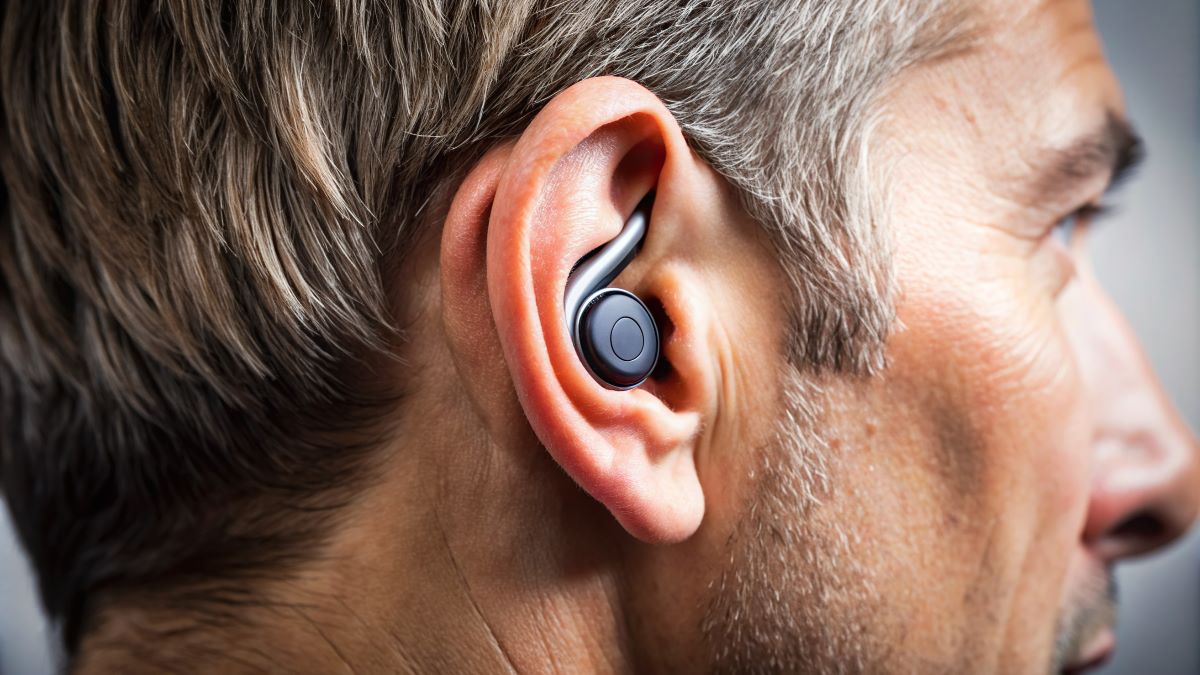
Streaming audio directly to hearing aids with Auracast
Remember the train station scenario from the beginning? With Auracast, you can tune into the audio of a broadcast directly to your headphones or even your hearing aids, with no more straining to hear over the noise of the crowd that surrounds you. The awesome news is that this goes for hearing aids too.
LE Audio introduces broadcasting of signals to any hearing aid user who is in the range of the transmitter that has a compatible hearing aid, meaning that with the press of a button or using the app for your hearing aids, you can activate the Auracast and you’ll be able to connect to the Auracast transmission.
LE Audio adds lower latency, lower power consumption, and a better quality signal to Bluetooth hearing aids too, and this allows developers to offer more features without impacting the battery life. In my opinion, this is going to have a hugely significant impact on the next generation of hearing aids being built.
We’ve already got Signia, ReSound, and Oticon who’ve got LE Audio built into their hearing aids ready for the global rollout of this Auracast transmission.
If you want to know more about the hearing aids that have this tech built in, then read our review of the best hearing aid technology of 2026.
Testing Auracast at Bristol Temple Meads
Travelling by train can be stressful enough, but for many people, the real challenge isn’t the crowds or the timetables. It’s the announcements.
It is incredibly common for commuters to struggle to hear what is being said over a train platform speaker. And it’s not just people with hearing loss; plenty of people have struggled to make sense of garbled announcements, often delivered through public sound systems that feel like relics from the past. But that’s about to change.
Bristol Temple Meads recently became the first train station in the UK to be equipped with Auracast, providing a real-world blueprint for how this technology operates in a public transport setting.
When standing on the platform, users can scan in and immediately hear the station announcements in crystal-clear quality, completely bypassing the usual hustle, bustle, and background noise. The process is entirely seamless: no fiddling, no guesswork, just clear, reliable information delivered straight into the ears.
Why Auracast matters for accessibility
For many people with hearing loss, the thought of missing a public broadcast brings real, tangible anxiety:
- Will I miss my train?
- Am I heading to the wrong platform?
- What if I don’t hear the last-minute platform or gate changes?
Auracast has the potential to remove that environmental stress. By making public announcements truly accessible, it actively works to:
- Boost confidence while travelling
- Improves independence in crowded public spaces
- Transforms hearing aids into what feels like a genuine superpower
And this isn’t just about travel. The rollout across UK venues is already underway, and the technology could soon be standard in airports, cinemas, conference halls, places of worship and beyond.
LE Audio & Auracast DESTROY all existing Bluetooth headphone audio…
Matthew Allsop is a Partner at Harley Street Hearing and the content creator for Hearing Tracker, where he shares his honest opinions on all things to do with hearing health and hearing aid technology. Hearing Tracker is the world’s first truly independent resource for hearing aid customers. You can watch his video on LE Audio & Auracast below.
Enjoy this article? You might be interested in some of our others here.